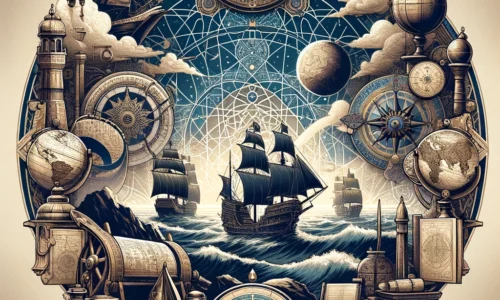
HIST 355: Islamic Maritime History and Exploration embarks on a fascinating journey through the maritime ventures and achievements of Islamic civilizations from the 7th century onwards. This course unveils the pivotal role Muslim seafarers, navigators, and explorers played in shaping global maritime history, highlighting their contributions to navigation, cartography, and cross-cultural exchanges. It explores how Muslims expanded their horizons beyond the familiar waters of the Mediterranean, venturing into the Atlantic, Indian Ocean, and even the South China Sea, establishing trade routes that linked distant lands and cultures.
The curriculum delves into the development of advanced navigational techniques and instruments, such as the astrolabe and the compass, which facilitated oceanic voyages and the mapping of new territories. Students will learn about the bustling ports and shipbuilding centers that flourished under Islamic rule and the exchange of goods, ideas, and technologies that occurred in these cosmopolitan hubs. The course also covers the legendary voyages of figures like Ibn Battuta and Zheng He, whose travels illustrate the spirit of adventure and curiosity that characterized Islamic exploration.
Through a detailed examination of historical texts, maps, and maritime artifacts, “HIST 355: Islamic Maritime History and Exploration” will provide students with an understanding of the economic, cultural, and scientific impact of Islamic maritime activities. By the end of this course, students will appreciate the interconnectedness of the world’s oceans and the significant contributions of Islamic civilizations to global maritime history.
Overall Objectives for this Course:
By the end of this course, students should be able to:
- Outline the key developments in Islamic maritime history and exploration.
- Identify the major navigational techniques and instruments used by Muslim seafarers.
- Analyze the impact of Islamic maritime activities on global trade and cultural exchange.
- Explore the contributions of notable Muslim explorers and their voyages.
- Examine the role of ports and shipbuilding in Islamic maritime dominance.
- Understand the significance of maritime routes established by Muslim navigators.
- Evaluate the historical narratives and primary sources related to Islamic maritime history.
- Discuss the influence of Islamic maritime exploration on later European expeditions.
- Reflect on the legacy of Islamic maritime endeavors in contemporary seafaring and navigation.
- Assess the interplay between maritime exploration and the spread of Islam and Islamic culture.
Curriculum
- 15 Sections
- 0 Lessons
- 14 Weeks
- Reading Project0
- Week 1: Introduction to Islamic Maritime History and Global Contexts.0
- Week 2: Navigational Techniques and Instruments in the Islamic World.0
- Week 3: The Role of the Mediterranean and Red Sea in Islamic Trade.0
- Week 4: Expansion into the Indian Ocean – Trade Networks and Cultural Exchange.0
- Week 5: Islamic Presence in the Atlantic and the Exploration of Africa\’s Coastline.0
- Week 6: The Age of Exploration: Muslim Explorers and Their Voyages.0
- Week 7: Ports, Shipbuilding, and Maritime Commerce in Islamic Civilizations.0
- Week 8: The Impact of Islamic Maritime Activities on Europe and Asia.0
- Week 9: Maritime Warfare and Piracy in the Islamic Mediterranean.0
- Week 10: Zheng He’s Voyages and the Chinese-Muslim Connection.“Seafaring in the Arabian Gulf and Oman: People of the Dhow” by Dionisius A. Agius. This book delves into the rich maritime culture of the Arabian Gulf and Oman, exploring the lives, traditions, and navigational techniques of the people who have historically sailed these waters. It provides a vivid account of the dhows and their sailors, who played a pivotal role in the maritime trade routes connecting the Islamic world with other cultures. Agius’ work is both scholarly and accessible, making it an excellent resource for understanding the significance of maritime activities in Islamic history and their contributions to global exploration.0
- Week 11: The Decline of Islamic Maritime Dominance and European Ascendancy.0
- Week 12: Cartography and Map-Making in the Islamic Tradition.0
- Week 13: Legacy and Modern Reflections on Islamic Maritime History.0
- Week 14: Summation and the Future of Studying Islamic Maritime Exploration.0
Instructor