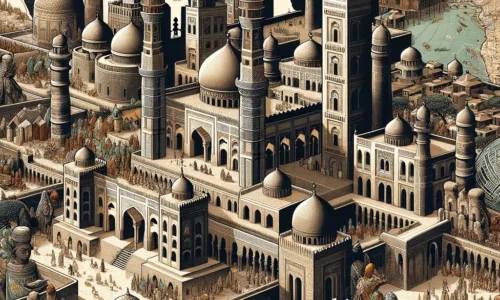
HIST 231: Islamic History in Africa delves deep into the rich tapestry of Islamic influence and heritage across the African continent, tracing the introduction and spread of Islam from the early 7th century through to the modern era. This comprehensive course explores the multifaceted dimensions of Islamic history in Africa, examining how trade, migration, conquest, and intercultural exchanges facilitated the embedding of Islamic traditions, knowledge, and institutions in diverse African societies. Students will engage with the complex narratives of Islamic states and kingdoms in North, West, and East Africa, such as the Almoravid and Almohad dynasties, the empires of Mali and Songhai, and the Swahili city-states along the East African coast.
The course also scrutinizes the role of Islam in shaping social, political, and economic structures within African societies, including the establishment of educational institutions like Timbuktu, the spread of Sufi brotherhoods, and the influence of Islamic law. Furthermore, it addresses the challenges and transformations faced by Muslim communities during the colonial and post-colonial periods, highlighting the resilience and adaptability of Islamic practices and the ongoing dialogue between African traditions and Muslim identity. Through a combination of historical analysis, primary sources, and contemporary scholarship, “HIST 231: Islamic History in Africa” offers an enlightening perspective on the enduring legacy of Islam in Africa and its role in the global Islamic civilization.
Overall Objectives for this Course:
By the end of this course, students should be able to:
- Understand the historical spread of Islam in Africa and identify key periods of Islamic influence.
- Analyze the establishment and impact of Islamic states, kingdoms, and empires across Africa.
- Explore the role of trade, migration, and religious missions in the spread of Islam in Africa.
- Examine the development of Islamic educational, legal, and cultural institutions in African societies.
- Discuss the contribution of African Muslim scholars, saints, and leaders to Islamic and world history.
- Assess the interaction between Islamic traditions and African cultural practices.
- Investigate the challenges faced by African Muslim communities during colonialism and their contributions to anti-colonial struggles.
- Explore the contemporary dynamics of Islam in Africa, including issues of identity, reform, and inter-religious relations.
- Critically engage with primary and secondary sources on Islamic history in Africa.
- Reflect on the diversity of the Muslim experience in Africa and its significance within the broader context of Islamic and world history.
Curriculum
- 14 Sections
- 0 Lessons
- 14 Weeks
- Week 1: Introduction to Islam in Africa – Origins and Early Spread.0
- Week 2: The Role of Trade Routes and Merchants in Disseminating Islam.0
- Week 3: Islamic Empires and Kingdoms in North and West Africa.0
- Week 4: Sufism in Africa – Orders, Brotherhoods, and Saints.0
- Week 5: Islamic Education and Scholarship – The Case of Timbuktu.0
- Week 6: The East African Swahili Coast and Islamic City-States.0
- Week 7: Islam and Pre-Colonial African Societies – Governance and Law.0
- Week 8: Colonialism and Islam in Africa – Resistance and Adaptation.0
- Week 9: Post-Colonial Challenges and Islamic Revival Movements.0
- Week 10: Islam and Gender in African Contexts.0
- Week 11: Contemporary Issues Facing African Muslim Communities.0
- Week 12: Interfaith Relations and Islamic Dialogue in Africa.0
- Week 13: The Global Impact of African Islam.0
- Week 14: Course Reflections and Future Directions of Islamic Studies in Africa.0
Instructor